Dollarize the portfolio
Map every URL to yield, risk, decay, attribution gaps, competitive pressure, and recoverable value.
See the audit →VerbEdge URL Ledger gives executives a performance-grade balance sheet for every URL: yield, durability, value-at-risk, impairment triggers, recovery actions, and policy controls across every discovery channel and AI-era system. URLs are the first asset class. The bigger shift is digital asset governance: assigning identity, evidence, ratings, policy, and economic logic to every web asset before agents, search systems, marketplaces, and tokenized infrastructure act on it.
Discovery is fragmenting. Attribution is breaking. AI agents are entering the workflow. Your digital assets need a ledger before the market starts pricing what you cannot see.
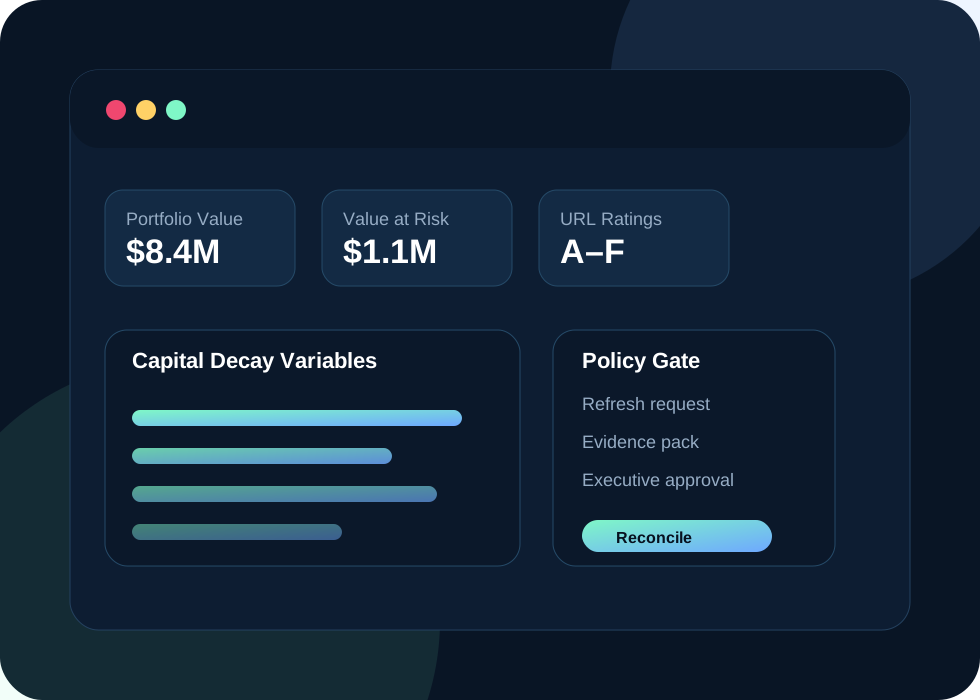
Most companies know what they spent to build the website. Almost none can say which URLs are compounding, which are impaired, which are cannibalizing yield, or which should be protected from human and agent action.
AI, algorithms, paid markets, partners, social feeds, email, direct traffic, CRM attribution, and agents all interact with the same URL assets. Your reporting stack fragments the truth across dozens of systems.
Start with a dollarized portfolio audit. Convert every URL into a rated, governed asset with identity, evidence, policy, and economic logic. Then operate the recurring URL Ledger as the control layer for ratings, benchmarks, governance workflows, audit trails, and agent-ingress controls.
Map every URL to yield, risk, decay, attribution gaps, competitive pressure, and recoverable value.
See the audit →Assign every URL identity, ownership, evidence, policy, lineage, performance history, and economic logic.
View platform →Run ratings, benchmarks, approvals, audit trails, protected zones, evidence packs, and agent-ingress controls from the same ledger.
See governance →A URL must have a canonical identity, lineage, owner, status, and evidence trail before it can be valued or governed.
Ranking systems, recommendation systems, marketplaces, feed algorithms, and answer engines can reprice URL value without warning.
Organic, paid, social, email, referral, direct, partner, CRM, and agent surfaces all read the same assets but report truth differently.
Markets do not stand still. Competitors publish, reframe, undercut, cite, advertise, and replace your strongest pages.
Navigation, taxonomy, internal links, hubs, breadcrumbs, and site depth determine whether value can flow to priority assets.
Duplicated, redirected, merged, split, parameterized, and near-identical URLs create identity confusion and value leakage.
See exactly how the platform works before making a decision. Explore the audit methodology, sample deliverables, valuation models, benchmarks, and implementation approach used to govern URL portfolios.
Inputs, outputs, cadence, and executive value proposition.
Download →What executives receive after a portfolio repricing.
Download →Model portfolio value-at-risk and recoverable value.
Download →Pipeline leakage surfaced in comparison, implementation, and proof clusters.
Read case →Category value was trapped by structural hierarchy and channel fragmentation.
Read case →Enrollment yield improved after decaying course assets were repriced and governed.
Read case →The first engagement is designed to produce a board-readable value-at-risk model, a ranked recovery backlog, and the operating rules needed to prevent re-decay.